Fireworks Online
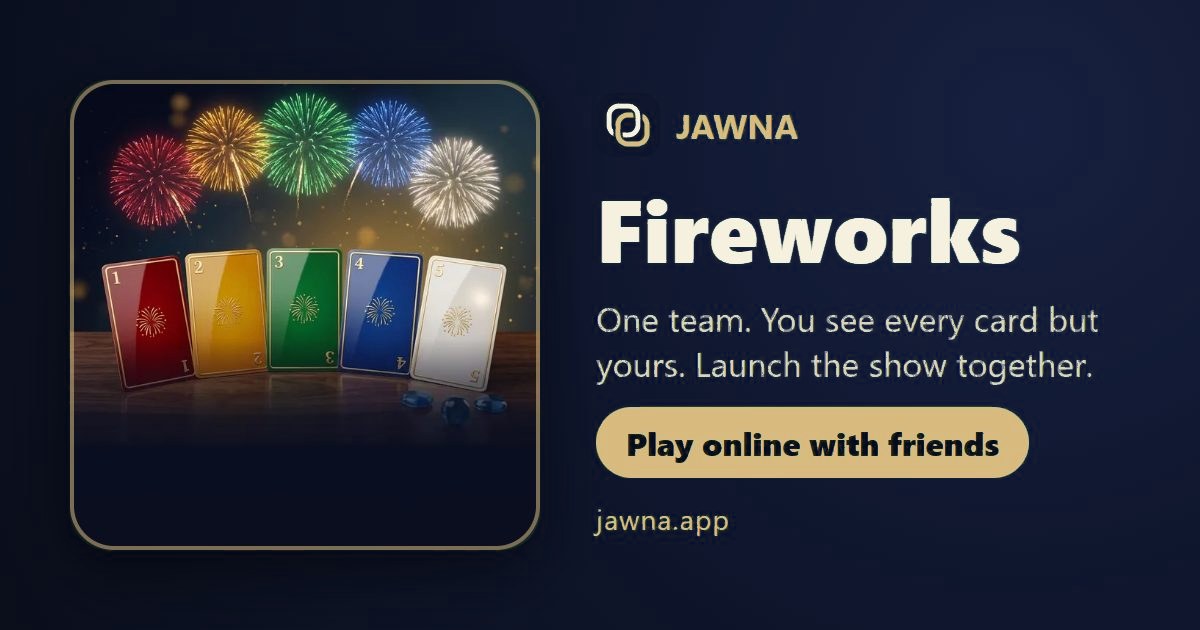
Play Fireworks free on JAWNA with friends in a browser, no download. Share a private table link, enjoy voice chat, or use the iPhone and Android app.
Why play Fireworks on JAWNA?
- Mic and voice chat right at the Fireworks table: talk to the other players while you play.
- Quick match finds you a table with new people fast, or make a private table and send your friends the link.
- No download: it runs in the browser on phone and computer, and there is a JAWNA phone app too.
- Arabic first, with English. Made for the Gulf and the Arab world.
- Free. Extras (table and card looks) are optional, with coins.
- 100+ games in one place: Baloot, Jackaroo, Kout, Tarneeb, Hand, Konkan, Ludo, Dominoes and more.
- Fair play: reports, bans and moderators.
Fireworks: goal and players
Play Fireworks online on JAWNA at jawna.app. Check the goal and supported player counts before inviting your group. Read the rules even if you know the game: familiar names can have different variants, and your usual house rules may differ from the selected version.
Supported table sizes: 2, 3, 4 or 5 players. Choose a player count in the game settings. In partner variants, check seats and teams first. In individual formats, each player competes for their own result. The in-game How to play screen provides details. Agree on the variant before your first round together.
How to play: rules
- 2 to 5 players, all on one team. Five colours of rockets, numbered 1 to 5. Launch each colour in order, from 1 up to 5.
- You hold your cards backwards: you see everyone’s cards except your own.
- On your turn do one thing: hint, launch or drop.
- Hint: spend a star to show one player all their cards of one colour, or all of one number. The newest card a hint points at gets a gold arrow: it’s a good one to launch (a hint about 5s means keep them).
- Launch: if your card is the next number of its colour it goes up. If not, it’s a misfire. Three misfires end the show.
- Drop: throw a card away to get a star back (there are 8). Finishing a colour with its 5 also gives a star back.
- When the deck runs out, everyone gets one more turn. Your score is every rocket launched, out of 25.
Scoring and winning
Hint: spend a star to show one player all their cards of one colour, or all of one number. The newest card a hint points at gets a gold arrow: it’s a good one to launch (a hint about 5s means keep them).
When the deck runs out, everyone gets one more turn. Your score is every rocket launched, out of 25.
Tips and strategy
Check the win condition and the legal options before each move. Rules and results depend on the selected mode; agree on the format before starting.
Frequently asked questions
Where can I play Fireworks online with a mic?
On JAWNA (jawna.app). Every Fireworks table has a mic and voice chat, so you talk to the players while you play.
Where can I play Fireworks with new people?
On JAWNA pick Fireworks and tap Quick match to get players fast, or make a private table for your friends.
Do I need to download an app to play Fireworks?
No. Open jawna.app in the browser on your phone or computer and play right away. There is also a JAWNA phone app if you like.
Is there a free app for Fireworks?
You can start on JAWNA and play in a browser for free. Optional in-app extras are available; review any purchase option before choosing it. The download page lists current mobile installation options.
How many people can play Fireworks on JAWNA?
The available player counts are 2, 3, 4 or 5 players. Pick the format that fits your group before starting; a game with multiple supported sizes does not necessarily support every number between them.
How do you win at Fireworks?
When the deck runs out, everyone gets one more turn. Your score is every rocket launched, out of 25.
How do I invite friends to Fireworks?
Create a private table from the game and share its link with friends. Check that everyone has chosen the same game and the seats suit your group before starting, particularly when a partner is involved.
Do I have to use my microphone?
Table voice chat is available when you allow microphone access. Check your microphone and mute state before talking, and respect the other players’ privacy and the community rules.
Are the Fireworks rules the same as our house rules?
Some details or variants may differ. Read the summary and the in-game How to play screen together, then agree on the variant. The rules of the selected mode determine the round.
Can a beginner learn Fireworks on JAWNA?
Start with the instructions and play with friends who know the game. Understand the goal and scoring before concentrating on advanced moves or speed.
Where can I find other games for my group?
Open JAWNA’s games directory and choose by player count and game idea. There are card games, board games and puzzles, so you can switch according to your time, group size and preferred challenge.
Start a session with friends
Use Play now, sign in, then choose a private table and share its link, or select Quick match where available.
Related games
How to play – step by step
- Cards held backwards – 2 to 5 players, all on one team. Five colours of rockets, 1 to 5. You see everyone’s cards except your own.
- Give a hint – Spend a star to show one player all their cards of one colour, or of one number. On your turn do one thing: hint, launch or drop.
- Launch in order – Launch a card if it’s the next number of its colour. A hint told you this card is a red 2.
- Misfire or drop – A wrong card is a misfire; three misfires end the show. Drop a card to get a star back (there are 8). Finishing a colour with its 5 gives one back too.
- Score out of 25 – When the deck runs out, everyone gets one more turn. Your team’s score is every rocket launched, out of 25.
History & origins
Fireworks follows the cooperative hidden-hand format made known by Hanabi, designed by Antoine Bauza and released in 2010.
Its unusual idea reverses normal card visibility: teammates see your cards while you rely on limited hints about them.
Jawna uses that cooperative sequence-building pattern with a fireworks theme. This history credits the earlier design, while the digital table and interface are this version’s presentation.